
HILCore
Detailed overview of the HILCore processor, including its solver and supplemental resources supporting various real-time applications.
HILCore Overview
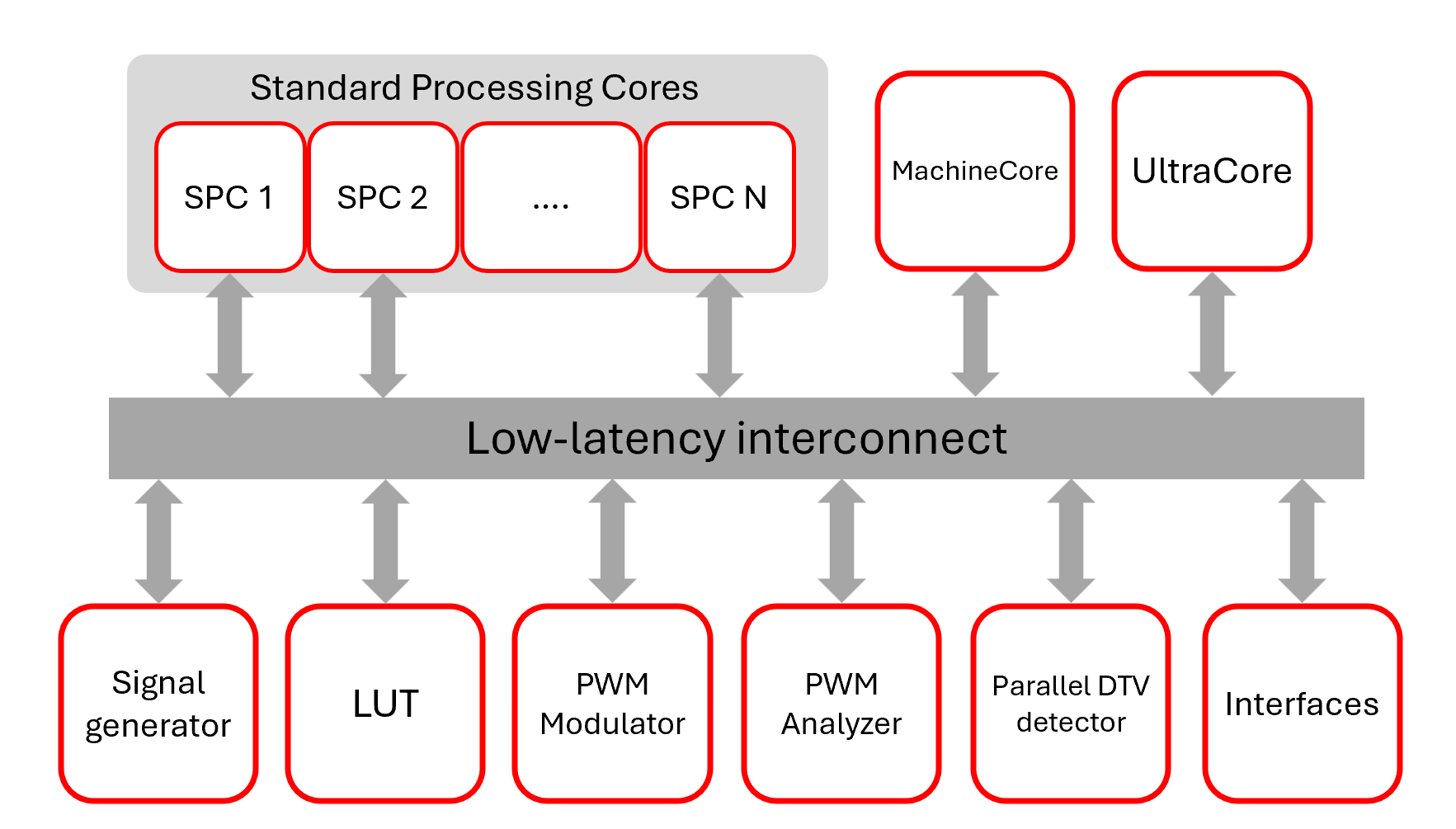
HILCore is a comprehensive, high-performance FPGA-based processor built for Hardware-in-the-Loop (HIL) applications in power electronics and grid systems. It enables real-time emulation of complex converters, drives, and power networks with high fidelity and nanosecond-level resolution, supporting control algorithm validation and digital twin applications. HILCore comprises a multitude of specialized, highly integrated functional units that are available in multiple configurations.
The basic HILCore architecture is depicted in Figure 1 where some functional elements are omitted for simplicity. The architecture is highly scalable and is used on all Typhoon HIL devices.
Descriptions of major HILCore solver resources are provided below. Additionally, a complementary overview of some of the HILCore resources is available in the Video Knowlegebase and as part of the HIL Fundamentals course.
HILCore Configurations
HILCore features a scalable architecture that allows for versatile combinations and parametrization of functional units, making it well-suited to a wide range of HIL devices and application domains. The HILCore processor is available in multiple configurations for each HIL device, organized into three tiers based on resource capacity and advanced feature sets as shown in Table 1.
In addition to the standard configurations available with THCC installation, users may request tailored HILCore configurations to meet their specific requirements, provided these are within the hardware limitations of the chosen device. For more information on Custom configurations, please contact Typhoon HIL via the ticketing system or request a custom configuration for your site.
| Available features | HILCore Base | HILCore Pro | HILCore Max | |
|---|---|---|---|---|
| HIL device availability | Included with all | Available on all | Available on 5- and 6-series | |
| HIL configurations included | Base only | Base and Pro | Base, Pro, and Max | |
| HILCore solvers | ||||
| SPC units | 2 | Up to 8* | Up to 8* | |
| MachineCore | 1 | Up to 2* | Up to 4* | |
| UltraCore | Up to 2 | Up to 2* | Up to 2* | |
| HILCore Additional Resources availability | Yes | Yes | Yes | |
| Custom configuration support | No | Yes | Yes | |
SPC
The SPC is a flexible and programmable circuit solver capable of sub-microsecond time steps and nanosecond-level switching resolution. The SPC unit supports both ideal and non-ideal switch models, with advanced features such as real-time calculation of power losses and support for time-varying passive components.
UltraCore
The UltraCore is an advanced circuit solver designed specifically for high-frequency SiC and GaN applications. It provides nanosecond-level time steps and is suitable for switching frequencies up to 1 MHz. More details are provided in UltraCore. The number of UltraCores depends on the solver configuration.
MachineCore
The MachineCore is a specialized computational unit which simulates a single electrical machine model including its electromagnetic part, mechanical part and speed measurement devices such as an encoder and resolver. The number of MachineCores depends on the solver configuration. For more information about the solver, please refer to the Machines documentation.
HILCore Additional Resources
HILCore also supports several additional hardware resources beyond the dedicated enhanced solvers mentioned above which broaden the application scope of Typhoon HIL devices. The amount of each these resources is determined by the specific hardware configuration.
The signal generator block is in charge of generating arbitrary waveforms at the full simulation rate. It is mainly used for independent voltage and current sources. It employs linear interpolation in cases when waveform sample rate is lower that the simulation rate. The number of signal generator channels depends on the solver configuration.
The Look Up Table unit is used to simulate behavior of nonlinear elements, such as PV panels, batteries, nonlinear passive components, and saturable transformers. The number of LUT channels depends on the solver configuration.
The multi-channel triangular/sawtooth PWM modulator can be used both internally, to drive internal converter models, and externally, through digital outputs. It runs on the FPGA internal clock and features a built-in dead time generator. The number of PWM channels depends on the solver configuration. The PWM modulator frequency is based on the IO timing of the HIL device. More information is available in the IO Timing section of each HIL Simulator device's documentation.
PWM analyzer is the unit which provides detailed analysis of digital inputs of the HIL device. Sampling resolution is determined by the IO timing of the HIL device. More information is available in the IO Timing section of each HIL Simulator device's documentation. It is utilized via PWM Analyzer component.
A dedicated hardware unit used for detecting shoot-through conditions between two or more converters connected in parallel. When using a HIL device with Parallel DTV Detector support, a number of Parallel Converter DTV Detector components can be added to the model to detect these conditions and report them through the standard DTV flag available in both HIL SCADA and HIL API.